Davide Casali = Folletto Malefico: Hybrid Interaction Designer = Design × Psychology × Technology / Simplicity × Complexity

Firefox, Safari, Lion and prototype ideas spreading

I think it’s always great when people contaminate each other with ideas, implicitly or explicitly, and it happens to improve something for all of us. This is exactly what seems happening recently.

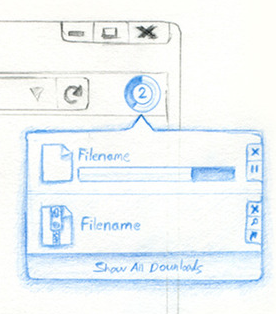
Limi, a great person and UX designer, was working on the design of the Download manager for Mozilla Firefox. In 2010 he wrote a very detailer article on “Improving download behaviors in web browsers”, that summarized the concept with a sketch by Stephen Horlander, this one:
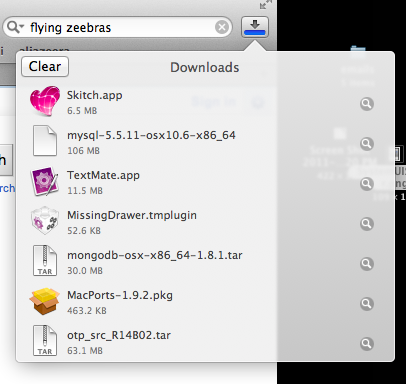
Fast forward to 2011 and it Limi notices a post by  Dustin Curtis, that shows Apple’s work on a new download manager for Lion. How does it look like? Here it is:
What makes me particularly interested in this is that in 2009 I worked for a bit on a few concepts for a redesigned web browser download manager and I had a brief mail exchange with Limi himself, where at the end I sent him a couple of wireframes. In these tried different solutions to avoid the nasty popup window warning (my first issue in order of priority), and one of the proposals removed the download window entirely. Here you can find the full wireframes pdf with all the ideas, while here’s a summary of the one that’s very similar:
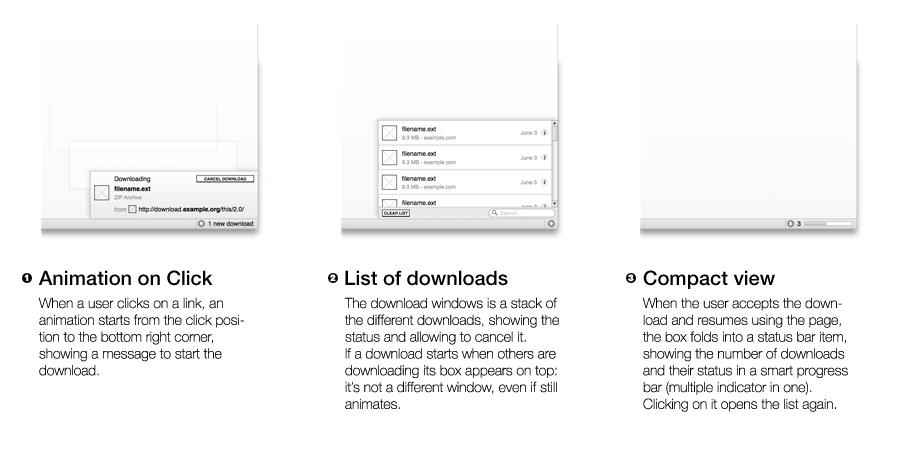
Being 2009, the only problem of this approach is now evident: today the bottom status bar disappeared even from the latest of all the browser, Internet Explorer (9.0). But what’s is interesting to me is that the interaction model is still that one, even if Limi and Apple’s solutions have it positioned in the top right corner.

I’d like to make two more considerations:

  1. I think that the animation is quite important in making it obvious without any “added” complexity, and I wonder if the current Lion’s version of Safari does that.
  2. I think that the idea itself isn’t really novel, so I’m not posting this piece to claim anything but to show how similar idea have at the same time a connection and have been replicated in “isolation” from different people.

In the end, however, I think that the “download” concept should become transparent for the final user, and that’s something that should be provided as both a system service and interface from the underlying operating system.
But that’s probably a topic for another time… ;)

Silvano:

Hi Davide,

it seems incredible and fascinating how so similar ideas pop-up simultaneously around the world! Thank you for sharing this interesting work.

I don't completely agree with the closing sentence of the post. I'm not sure that the download process should be completely transparent: where it is, it's often source of confusion and disappointment. I think about the way in which IE opens Office documents: actually the browser downloads files, but the process is so invisible that the normal user downloads again and again the same document because of the fact that IE saves the documents in a hidden, temporary folder without advice to the user.

I think that transparent is a dangerous adjective: it can be associated with the word invisible, while usually people need to see the right amount of information.

Davide 'Folletto' Casali:

In interaction design, and especially in UX design, "transparent" for everything that doesn't build up the experience is the final objective.

In the specific situation you commented - that, as said, is more than worth a bigger post - it means that you need to achieve the proper user feedback without giving also the burden of the download process. Today, you have to click on links, download, click on a couple of windows, reach the specific folder, etc.
It's not far fetched thinking to have a system, system wide, that allows the management of all of this without a single intervention from the user, but with the right amount of feedback (for example an incomplete downloaded file, waiting times and such).

If you think about it, mobile OSes are already trying to find solutions to this problem, even if taking the problem from another perspective (that means, removing the "file" concept).

Silvano:

I agree with you, Davide: full-of-click-download-system nowadays present on browsers are far from being the best solution to the problem and system wide tool for managing download seems a good path to follow.

By the way, I personally think that what happens on mobile OSes with files disappoints as many users as the IE too transparent download system. I'm pretty curious to see where the mobile devices will be heading for.

Davide 'Folletto' Casali:

Exactly, IE is quite bad at it, and the current breed of mobile OSes is basically "forcing" to rethink it because they lack the concept of files... not really a good way to drive it forward, but at least it's forcing a little bit of innovation. :D

blackdog:

It is always intersting to notice how ideas permeate from a design to another. I have some ideas too for example, and they point toward the same direction of your article conclusion: i think there would be better user experience if there was a tighter integration between the software parts.
It woul be better drwan than explained :D

Do you have something to say? Please add it here:

(optional)